jump to navigation

Here comes the sun!!! May 13, 2008

“Little Darling…it’s been a long, cold-lonely winter.  Little Darling, it seems like years since it’s been clear.  Here comes the sun,”

…so “they”: say.  I’m delayng this listing one day from Wednesday to Thursday, hoping for a bit of blue sky and sunshine.  My iPhone tells me it will be sunny from Thursday until past Sunday!  Do I dare believe it!?!?  Oh well, I’ll have some backup gray sky photos just in case.

Planning to run around taking as many sunny photos of other listings on Thursday and Friday too.  Anyone with snow photos ought to do the same.  Thursday is Picture Day..with Friday as a backup.

This morning I was singing Sesame Street’s “Sunny day, everything’s A-OK” but it was driving Kim nuts…so I switched to the Beatles.

Sunny in Seattle Soon

Sphere: Related Content

Sunday Night Stats - King County May 12, 2008

In January of 2007, 455 people were able to sell their homes in 30 days or less at 99.84% of asking price.

In January of 2008 only 261 people were able to sell their homes in 30 days or less and they sold at 98.93% of asking price.

42% fewer people sold their homes within 30 days of listing the home for sale in January 2008 vs. January 2007

In January of 2007, 13.25% of all homes sold had been on market for over 120 days and sold for 97.52% of asking price at time of sale.

In January of 2008, 21.67% of all homes sold had been on market for over 120 days and sold for 95.60% of asking price.

And yet…they sold for a little more.  Volume down by 30%, days on market longer, but median sold prices up from $430,000 to $431,375.  Median asking prices up from $430,014 to $439,000.

That was January…let’s jump to April (I don’t know the answers before I type this BTW.  I figure I can’t introduce my agent bias if I post in real time.)

In April of 2007, 1,184 people were able to sell their homes in 30 days or less for 100.62% of the asking price.

In April of 2008, only 561 people were able to sell their homes in 30 days or less and they sold at 99.25% of asking price.

53% fewer people sold their homes within 30 days of listing the home for sale in April 2008 vs. April 2007

In April of 2007, 13% of all homes sold had been on market for over 120 days and sold for 97.8% of asking price at time of sale.

In April of 2008, 20% of all homes sold had been on market for over 120 days and sold for 95.97% of asking price.

But in April, no more volume down; prices up.

Median sold price in April of 2007 was $474,950 ($50 less than median asking price)

Median sold price in April of 2008 was $451,250 and median asking price at time of sale was $459,925

 Volume Down 32% 2008 YTD vs. 2007 YTD

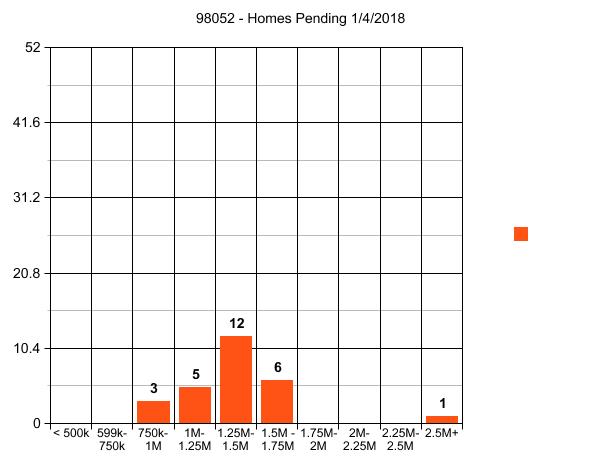
By Request: Stats for “Curious” in Redmond 98052 pretty strong relative to King County as a whole.  Also for Curious - Woodinville 98072; not a pretty picture.  For Aiboh here’s 98074 Sammamish - not bad.  A lot better than Woodinville.  I have to put the special request stats on my blog for space purposes.  But keep the requests coming and if I can’t do them on Sunday night, I’ll squeeze them in during the week somewhere. 

Regular weekly stats:

King County Residential

Actively For Sale: 11,231 - UP 268

In Escrow: 2,813 - UP 63 - MPPSF $210 (dropped $2.00 again - and that’s asking price

Closed YTD 5,414 - UP 305 - MPPSF $220 YTD (April MPPSF $224)

Not sure why closed sales keep running high while the properties in escrow are running low as to median price per square foot.  You would expect the closings to be affected eventually as these close, but so far not.

MAYBE a lot of the ones staying in escrow are short sales, and they are not closing at all.  That would be the only explanation I can come up with for “in escrow” MPPSF running lower and lower and closings not being lower. 

King County Condos

Actively For Sale: 3,890 - UP 106 MPPSF $320 Down $3.00

In Escrow: 940 -UP 40 - MPPSF $303.50, Down $1.50 but close to where they were the week before last.

Closed YTD: 1,776 - UP 101 - MPPSF $288 - asking prices still running high relative to closed prices.  Especially considering April closed sales are running at $270 MPPSF compared to April 2007 at $300 MPPSF.

Volume down 52% April YOY in condos and prices are starting to see more signs of weakening.   But again, given the sold properties in both residential and condo were on market for a long time, we could be seeing some old inventory selling off at drastically reduced prices.  Some old stale inventory is runing scared from “new on market” and dropping prices accordingly.  

Sphere: Related Content

Just got the news! Another Grandchild on the Way! May 6, 2008

My daughter Jacquie just called, the middle child, she and Peter are going to have a baby!  This will be my second grandchild.  See Jacquie below at the 7 Eleven at Denny and 5th.

Sphere: Related Content

Sunday Night Stats on Monday Morning May 5, 2008

Did you ever work so hard in a week, that you just needed to lay down for 20 minutes after dinner and didn’t wake up until the next morning!?  Sure you did.  It happens to all of us.  Well, that’s what happened to me last night after my Open House in Bryant and after inputting a new listing in Redmond.  Just took a nap and never woke up until 6:00 a.m this morning.

In this business the days sometimes just keep running together one after the other and you forget when you last had a day off, or a haircut, or your nails done.  You just keep working day after day until the job is done, and the time frame just keeps switching from this “right now” to the next “right now”.

There is no “have a nice weekend” in real estate.  There is no “what’s your schedule like” in real estate.  On any given day the phone rings and sets a chain of events into motion that has no end until the work is done.  And when your clients have small children, you really roll up your sleeves and pitch in until the house is ready for market.  I have 4 sets of clients with children, all getting their houses ready for market, and 2 of the 4 moving to new houses nearby.  The work is back-breaking, but very satisfying when the job is done and the home is photo ready and Open House ready and Broker’s Open ready, and then you do the photos and the Open Houses and the Broker’s Opens, and it just keeps going until the house is sold.

Everyone wants a list of what an agent does.  Truth is we do whatever it takes to achieve the objective.  Everyone working all at the same time, owners of the homes and agents alike, all working toward the common goal of getting everything just so and on market.

Whether it’s a home built in 1910 in Bryant:

Seattle Home in Bryant

Bryant Home

Or a newer townhome in Redmond:

Rivertrail in Redmond TownhomeRivertrail Townhome

Perfection is the expectation of buyers.  So you just keep working till you get it as perfect as you can.  And the poor Moms who live there with their small children, have the undaunting task of trying to keep it that way day after day.  Getting the kids ready for school and leaving the house in perfect order for showings, is no easy feat.

So this Mother’s Day I ask that you all give honor to the Mom’s with homes on market…and the Mom’s like me who turn into everyone’s Mom when helping them get the job done.

************************

And now for Sunday Night Stats on Monday Morning.  I won’t be doing the April month end stats until next week, as there will be many month end closings posted during this week.  So let’s just do the normal weekly stuff. 

I expect if I’m this busy getting properties on market, two on and at least three to go over the next few weeks, that every agent is busy prepping homes to get them on market.  So inventory should be rising even more in the next 30 days.

King County Residential:

For Sale:  9,372 at a million or less - DOM 53 - MPPSF $225.58 and 1,591 over $1M - DOM 68 - MPPSF $371 Total Residential King County homes on market this morning 10,963.  That is 135 more than last week, after netting out those that went into escrow from those that came on market this week.

In Escrow: 2,750 - DOM 45 - MPPSF $212, that’s 81 less than last week due to month end closings with MPPSF dropping from $214 to $212.  That reflects a drop in asking prices, not sold prices.  Expectation is the sold prices of those 2,750 will be less than the $212 MPPSF asking prices.  Though some did sell for over asking price with multiple offers, the median will likely be more like $210 or so.

Closed YTD: 5,109.  That’s 463 more than last week with DOM of 51 days and MPPSF of $220 for the year to date which is up a buck for closed sales.

Given the median days on market for In Escrow is going down, the price issue of down to $212 MPPSF for those in escrow, is likely due to increased competition and homes coming on market being more realistically priced to sell.  At least for the ones that are actually selling and going into escrow.

***************

King County Condos:

For Sale:  3,784 - that’s 10 more on a net basis than last week.  DOM 57 - MPPSF $323 (about the same)

In Escrow: 900 - that’s 46 less than last week due to month end closings - DOM up from 43 to 48 - MPPSF up from $303 to $305.  Remember those are asking prices, not sold prices.

Sold YTD: 1,675 up 158 over last week - DOM 48 - MPPSF $288 - that is DOWN from $290 last week and EQUAL to the MPPSF of 2007 all months combined.  Given most of last year was strong, condos just now reaching MPPSF of all of last year is a pretty strong statistic for condos.  You would think all of this year would be equal to the last 5 months of 2007.  But they are still running high relative to 2007 compared to the single family home market, but starting to dip on a YOY basis, which is to be expected. 

Amazing how strong the condo market is.  I suspect new construction and condo conversions are giving resale condos a run for their money and strong competition.  That is keeping the MPPSF up, though for resale…not necessarily so.

That’s it for Stats this week.  When I do month end stats for end of April YOY next week, we’ll break down some of the areas like “within 2 miles of Microsoft” and certain Zip Codes from weak ones to strong ones.  So if you are hoping to see a break down of a given area, it’s time to get your requests in for next week.      

One of our agents listed a property at $350,000 in Tacoma three weeks ago and has had NOT ONE showing since it was listed.  My listing in Bryant listed at $529,950 had 6 showings in the first two days + more than 20 people at the first Open House yesterday.  So there is a lot of difference in activity from one area to the next.

Getting the property ready for market, and good photos, have become critically important.  No more stick the sign up “as-is” and wait for offer…    

Sphere: Related Content

“It’s Microsoft’s World, Kid… May 1, 2008

I just live in it.”

That was the line in CSI: NY last night, where Microsoft’s Photosynth was used to reconstruct the events prior to and during a crime at a high school prom. They loaded up all of the photos taken on every student’s cell phone ( a big box of them).  Then they used Photosynth to timeline the victim and suspects whereabouts in the moments before the Guidance Counselor was slain.  One of my clients worked on this program, so I was “tuned in” last night. 

Rather than my trying to explain what Microsoft Live Labs Photosynth is, for those who didn’t see the show last night, here’s a video that Robert Scoble put up when Photosynth was the hit of the O’Reilly Web 2.0 Summit in the Fall of 2006.  Here’s another great and even better video called Nasa meets Photosynth

Another description from Wikipedia: “from Microsoft Live Labs and the University of Washington that analyzes digital photographs to build a three-dimensional point cloud of a photographed object.[1] Pattern recognition components compare portions of images to create points, which are then compared to convert the image into a model.”

The program last night and the Nasa meets Photosynth video give some great examples of how this technology can be used.  In the comments someone noted that he might be able to ”watch his child grow up” by using this technolgy, and someone else referenced a marriage of Flickr and Photosynth for multiple purposes. 

As a side note, I am one of those people who didn’t like Bill Gates too much, until I saw him “honored” in the eyes of a friend from India.  Watching my friend speak from the standpoint of “anything is possible”,  I realized what a huge role model Mr. Gates is for so many young people with dreams. When I see young people striving to become great in their own right, every single day, spurned by the idea that “everyone can be great…just like Bill Gates”, I bless Mr. Gates for his ripple effect.

Someone bought me an Apple computer…I refused to use it for six months and then gave it back.  On the other hand, they are going to have to pry my iPhone from my cold dead hands…until Microsoft comes out with a replacement product :)

Sphere: Related Content

HELP! Techie Problem! I’m going NUTS! April 30, 2008

I really need this fixed yesterday.  It’s driving me NUTS!

For almost a month our WordPress Blog here has been malfunctioning for me and only me.  Not Rhonda.  Not Dustin.  Just ME!  I am not getting an email when someone posts a comment on one of my posts.  So I have to come here WAY too often to see if someone is “talking to me” and I have to answer quickly and get back to what I am doing.

I have to check the site mega times a day, instead of simply seeing the question in my email.  And if someone leaves me a comment and it rolls off the sidebar while I’m working, I risk ignoring someone who asked me a question, which I don’t like to do.

The result is that I’m commenting like a madwoman by coming here ALL the time, instead of just working and seeing an email come in when I get a comment on one of my posts.

I’m going NUTS!!!!!  I’m busy up to my eyeballs and I just can’t put up with this one more day!

Dustin and I have tried everything we can think of to fix this problem.

So if you have a WordPress blog, and have ANY suggestions as to why the comments are not causing me to get an email (and yet everyone else still is getting theirs) PLEASE, PLEASE HELP!  Any and all suggestions appreciated.  I’m going out of my mind and it’s starting to be noticeable in my writings.  Please help me.  This must get fixed.

Thank you.
 

Sphere: Related Content

Condos - How much should be in reserves? April 29, 2008

I have written posts in the past about this topic noting my chagrin that WA didn’t have a Law that required Condo Homeowner Association Boards to have a Reserve Study done.  Well I’m pleased to announce that such a law was passed.  Here’s a link to Elizabeth Rhodes of the Seattle Times article on the subject.  The law has no teeth yet, and has everyone confused for a lot of reasons, but it’s a step in the right direction.  Rome wasn’t built in a day.

This is a subject that is near and dear to me, because I have witnessed too many times the long-term affect not having a Reserve Study, or a requirement to have a Reserve Study, has had on Seattle Area condo buyers and sellers.  I am so happy about this new law I could stand on my head and spit nickels.

If you are on a condo Board of Directors, this is a VERY important concept for you to understand and embrace.  Please post any questions you may have about the importance of a Reserve Study (not the law “requiring” it) and I will be more than happy to expound on the topic to the extent of my ability.  I’m a real estate agent, but I had the opportunity to manage several associations and help them with Reserve Study requirements in “a past life”.  I also understand the relationship of Reserve Study to setting accurate monthly dues.  And last but not least, how very important it is to buyers of condos to have a Reserve Study Summary Page in the Resale Certificate.

HOW MUCH SHOULD THERE BE IN RESERVES?

Honestly, no one can answer that question unless there is a Reserve Study done and the ability to review the Reserve Study.  Here’s why.  Condo Reserves are not about HAVING reserves.  In fact, having too much in reserves can be just as harming to an Association and condo values, as having too little.

Putting money in reserves is not like saving X% of your money for “a rainy day”.  Putting money in reserves is like saving for a new bike when you were a kid.  You want a bike.  It costs $100.  You know if you can earn and save $20 a week, it will take you five weeks.  If you buy the bike, but have the foresight to know that you want a new and better one next year, you might set the bogey at $250 for a new bike in 12 months and save $5.00 a week to that end.  When you have the $250, you get a new bike, or you stop saving for that particular item at that point.  Reserve Studies are THAT simple. 

In a Condo Association you are like a kid saving for a new bike for every “major component” of your property.  NOT ANNUAL MAINTENANCE ITEMS, but REPLACEMENT COST items.  So how much is enough and how much is too much to have in reserves?  If you don’t have $250 the day you are scheduled to go get the new bike…not enough.  If you still have $250 in the account the day AFTER you buy the new bike, you saved too much.  The danger of saving too much is that you have falsely created a monthly condo fee that is too high, and your property values may have been damaged as a result.

HOW IS A RESERVE STUDY DONE AND HOW MUCH DOES IT COST?

A FIRST TIME Reserve Study will cost a lot.  About $2,500 depending on the size of your Association.  A 20 unit complex with no amenities Reserve Study will cost less than a 700 unit complex with two pools, an exercise room, two lakes and 8 elevators :)  After the first one is done, the updates cost much less and usually no one has to come out and the update is “a computer function” of numbers adjustment.  You tell them you just replaced the mailboxes, and they do a reset of Useful Life for that item and spit out a new page and Reserve Study Summary.  A simplification, but you get my drift.

Someone comes out and makes a list of Major Components.  The Board of Directors normally sets the dollar amount of “Major Component”, though the Reserve Study Company will make a suggestion or have a standard you can follow.  If you have 10 units and need a $2,000 item, it costs everyone $200 to get it.  If the cost of those condos is $450,000, then maybe asking everyone to chip in $200 is not a big deal.  But if the cost of those units was $159,000, then asking everyone for $200 IS a big deal.  If you have 700 units, then everyone kicking in $2.87 is no big deal.  Maybe you call that a “minor component” and save for that only if you have all Major Components covered.

THAT IS WHY the definition of Major Component is left to the discretion of the Board of Directors of each Association.  Fees being too high hurts you as much as fees being too low.  There is more than a $15 difference between dues of $295 a month and $310 a month, than $250 and $265 when it comes to property values.  The Board has to be aware of pushing that fee beyond certain “keypoints” without GOOD reason.

New Roof, Exterior Painting, Replacement of Fences, Resurfacing the Pool, new mailboxes, are examples of Major Components for most Associations.  NEW ELEVATOR is a really good example of why one Association with $500,000 in Reserves can be BETTER than another with $750,000 in Reserves.  If the second has 3 elevators, or a very expensive many floor elevator, their Reserve Needs will be higher than an Association with no elevator and other similar Major Components excluding elevator.

(Kim asked about windows - no not windows or sliding glass doors or garage doors.  Almost always they are “owner responsibility” items as to cost.  The Association chooses the contractor to be used and type of product, but since the owner pays, these are not part of the Reserve Study.  Each Association is different, but as a general rule, know that these items are not part of what an Association pays for as to replacement.) 

WHAT DOES ALL THIS HAVE TO DO WITH MONTHLY DUES?

Monthly dues are a combination of two numbers.

1) Monthly amount needed for Operating and ongoing Maintenance.  Landscaper (not replacement cost of trees but the cost of monthly service).  Property Management Fees.  Cost of electricity for lighting the common areas.  Regular pool maintenance and chemicals (not resurfacing or pump costs)

Let’s say Operating Costs are $5,000 a month and there are 50 units.  $5,000 divided by 50 equals $100 in dues for Operating Costs. Many Associations do not divide evenly by number of units, they do it by square footage or value of units, but I’m trying to keep this simple.

2) Reserve Needs.

A Reserve Study will spit out a final number and tell you what you need from each owner, each month, to have enough for replacement items. 

Let’s say they need $30 from everyone for an eventual new roof, $20 for new siding some day, $10 to repaint the place every 10 years to increase the life expectancy of the existing siding and $40 for all other major components combined.  Then the Reserve Study Summary will say you need $100 from everyone, every month, for “Reserves” and you must put that money in Reserves every month FOR THAT EARMARKED PURPOSE! 

IN THE ABOVE EXAMPLE, DUES SHOULD BE $200 A MONTH, NO MORE AND NO LESS.  $100 for monthly operating costs PLUS $100 to put into Reserves.

HOW DO I AS A CONDO BUYER OR OWNER KNOW IF THE AMOUNT IN RESERVES IS ADEQUATE?

There is a RESERVE STUDY SUMMARY that IMNSHO should be in every Resale Certificate and submitted to every owner once a year at the AGM (Annual General Meeting) or Budget Meeting (often the same meeting).  It’s a few pages.  The actual Reserve Study is a big book with photos, and so usually not distributed out to anyone who wants to have it.  Though it is usually available for review and by appointment upon request.  Often every Board Member gets their own copy, but other Association Members do not.

The Reserve Study Summary will list all major components, their useful life, and their Remaining Useful Life. These will be shown in columns for every Major Component.  A quick glance of Remaining Useful Life Column will give you a feel for the health of the Association. If you see items with Remaining Useful Live ZERO, that’s a big red flag!  That means the item should have been replaced, but wasn’t.  Most reserve studies do not go into negative status like -5 years to let you know the item should have been replaced five years ago (I wish they did).  Most often they will say “0″.

This is a long topic, in fact it takes a chapter of a book to really explain it well, but hopefully the above offers some practical information you can use to comply with this new law.  It’s a good law.  Embrace it.  Don’t try to find the loophole to get around it. 

If you walk around an area with a lot of old condo complexes in disrepair, know that was caused by WA not having a Reserve Study Requirement, to some extent.  Know that a healthy Association is not only important to the owners of the condo units, the buyers of the condo units and the sellers of condo units, but everyone impacted by “an eyesore” in the neighborhood.

Sphere: Related Content

Sunday Night Stats - King County April 28, 2008

When I started Sunday Night Stats, I didn’t think this through as to what would happen when I ran into volumes that exceeded 10,000 units.  I can’t run stats for volumes over 10,000.  9,193 condos sold in 2007.  Inventory would have to exceed last year’s total sales for us to run into difficulty, and I don’t expect that to happen.  I also don’t expect sales to exceed last year’s, so let’s start with the condos tonight and add some relevant breakdowns.

Remember that “in escrow” prices are asking prices.  It’s easy to see why the properties in escrow are selling and why the ones for sale are not.  There’s a $20 per square foot difference overall.

King County Condos

For Sale - 3,774 - UP 68 - DOM 56 - median price $328,000 - MPPSF $323

1 bedroom condo - 1,056 - DOM 56 - median price $294,970 - MPPSF - $419

2 bedroom condo - 1,988 - DOM 58 - median price $340,000 - MPPSF - $312

In Escrow - 946 - UP 75 - DOM 43 - median price $299,950 - MPPSF $303

1 bedroom condo - 274 - DOM 31 - median price $269,500 - MPPSF - $394

2 bedroom condo - 472 - DOM 45 - median price $305,000 - MPPSF - $285

Sold YTD - 1,517 -UP 120 - DOM 49 - median price $284,000 - MPPSF - $290

1 bedroom condo - 418 - DOM 43 - median price $247,250 - MPPSF - $362

In 2007 - 2,676 - DOM 24 - median price $263,000 - MPPSF $386

2 bedroom condo - 787 - DOM 50 - median price $299,000 - MPPSF - $289

In 2007 - 4,742 - DOM 29 - median price $298,000 - MPPSF - $288 

King County Residential

To avoid any segment exceeding 10,000 for the rest of the year, I am breaking these down into three age categories, and then combining them at the end and carrying out the data out for any segment with 10,000 or less units. 

Built before 1970:

For Sale 3,624 - DOM 50 - median price $450,000 - MPPSF $248

In Escrow 1,097 - DOM 36 - median price $410,000 - MPPSF $234

Sold YTD 1,831 - DOM 43 - median price $410,000 - MPPSF $235

In 2007 - 9,651 - DOM 26 - median price $429,000 - MPPSF 246.

NOTE: The median asking price of the sold properties was $419,950.  So if the properties in escrow have the same relationship of sold price to asking price, expect to see prices down more than the $246 per square foot of 2007 to the $235 of closed year to date.  The properties on market are asking slightly higher than the price per square foot of last year in this age range, but are not getting it.

Built from 1971 to 1999:

For Sale 3,146 - DOM 53 - median price $535,000 - MPPSF $228

In Escrow 688 - DOM 51 - median price $439,000 - MPPSF $209

Sold YTD 1,207 - DOM - 56 - median price $427,000 - MPPSF $206

In 2007 - 6,778 - DOM 37 - median price $460,850 - MPPSF $220

Again, properties for sale are asking more than the $220 PSF that they sold for last year and getting less.  The asking price of properties sold year to date was $438,000.  So unlike the prior to 1970 category, the properties in escrow may end up at the same median price per square foot as the YTD closed sales.

Built 2000 or later:

For Sale 4,068 - DOM 66 - median price $594,950 - MPPSF $217

In Escrow 1,046 - DOM 55 - median price $479,000 - MPPSF $197

Sold YTD - 1,608 - DOM 59 - median price $475,043 - MPPSF $206

In 2007 -  6,956 - DOM 49 - median price $500,000 - MPPSF $207

The asking prices of the properties closed YTD was $484,995.  So those properties in escrow look pretty dismal both as to price AND price per square foot.

Total Residential Properties:

For Sale 10,828 - UP 209

In Escrow 2,831 - UP 191 - DOM 45 - median price $445,550 - MPPSF $214

Closed YTD 4,646 - UP 316 - DOM 52 - median price $438,163 - MPPSF $219

Median asking price of closed properties was $448,250.  1,627 of those sold in 30 days at 99% of asking price. 

Sphere: Related Content

Title and Escrow - Who Chooses? April 27, 2008

In this post I will address the topic from a practical standpoint, in chronological order, based on ”Common Practice”.  This post is written from the standpoint of “common practice” in the Seattle area, where Title and Escrow are two separate functions, and not combined as they are in “settlement” vs. “escrow” areas.  Areas that have “a settlement or ‘event’ closing”, operate differently.  After reading this, you will likely feel that something should change.  So posting on this topic is a great way to influence change, a side benefit to blogging in “transparent” fashion.

Nothing changes until its weaknesses are illuminated by discussion…so here goes.

1) The first thing an owner does (or the listing agent does on behalf of the owner) is contact a Title Company.  Most often, this is done BEFORE the property is listed for sale.

Most Title companies offer three levels of information/service:

a ) a “listing packet”

b) “Preliminary Title”

c) A full Title Insurance Policy

Often an agent will order a “listing packet” upon first getting a request to visit an owner at their home to discuss the property being listed for sale.  This level of information provides a basic legal description, a plat map, and some basic and general info regarding the property.  Some companies provide sale comps, but most experienced agents don’t rely on the Title Company for “comps” and do their own.  Personally I tell a Title Company not to waste their time or the paper producing comps for me.  I never find them to be useful, or as useful as the ones I do myself.

While in theory “the seller” orders Title as “common practice”, and By Law the Buyer is supposed to choose the Title Company (see RESPA below),  most often the agent has already been in contact with a Title Company before they even meet the seller. 

2) “Preliminary Title” is usually ordered by the agent as soon as they know that “they have the listing”.  Sometimes I do this as a first step, if I know the owners well enough to know that I will be listing the property before I go to the first meeting to discuss getting the property ready for market.  That gives me more info up front than the “listing packet” and saves the Title Company some time, and possibly a few trees, if we get “hard copies” or print out the info.

When an agent lists a property, part of the intitial input into the mls system is a field question that asks “Has Preliminary Title been ordered?”  Then there is a drop down box where you enter “Yes” or “No”.  The presumption is that the answer should be “YES” and often the Title Order # is included in the Agent Remarks section “Title Company is X order #X”.  To comply with RESPA, the buyer is supposed to choose the Title company.  So possibly this provision in the mls listing input should be eliminated.  You be the judge.  For now, that’s how it is.

In order to write an offer on a property, the agent for the buyer needs to access the legal description.  As soon as there is “mutual acceptance” of the contract, the lender needs to access the Title Order by company and Title Order #.  So without regard to the Insurance aspects of Title Insurance, the process of involving a specific Title Company happens long before there is a need to actually insure the property with regard to Title Issues.  At time of offer, the buyer has the option to choose Title and Escrow as part of the offer and is NOT obligated by law or contract to use the one who provided the owner and listing agent with services to date.  Still common practice does not follow that thinking…or at least hasn’t do date.  Maybe the people reading ths post will change that in the future.

3) Title Insurance Policy - Now we get into who pays and who chooses.  Up to this point, no one pays.  If the property never gets “signed around” and escrow is never opened, the Title Company has provided all of the services for free.  The title Company up to this point, provided these FREE services to the listing agent.  The balance is that the agent most often uses the same Title Company all of the time or most of the time, and so there is an offset of paid for services against the free services.  If owners ordered and paid for the services up to this point (vs. the agent), there would likely be a cost for the first stages that are currently offered free of charge if the house never sells.

Here in the Seattle Area we have OWNER’S Title and LENDER’S Title.  Owner’s Title Insurance is the manner in which an owner conveys “clear title” to the buyer.  The cost is based on the Sale Price and is paid for by the seller.  Lender’s Title is all about the buyer.  If it is a cash buyer, there is no Lender’s Title.  If the purchase is financed, then the buyer pays for that portion of the Title Insurance that insures the Lender and is based on the loan amount vs. the Sale Price.

RESPA - Basically RESPA provides that “the owner” gets to choose Title.  In this post I refer to “the owner” as the person who owns the property prior to closing.  Common pactice here is that the owner at time of listing the property “orders title”, at least Preliminary Title.  RESPA (Real Estate Settlement and Procedures Act) “entitles the homeowner to choose a title insurance company when purchasing or refinancing…”  and gives that right to the BUYER as “owner” and not the seller as owner.  In fact any seller who mandates the Title Company to the buyer is subject to a penalty of 3 times the cost of the Title Insurance.  This makes perfect sense in settlement States, but is a bit odd in in escrow States.   But it is what it is.  Back to common practice.

It would seem that the seller should CHOOSE and pay for Owner’s Title and the Buyer should CHOOSE and pay for Lender’s Title, simply due to the fact that the owner and listing agent need to review title information long before the buyer is a known entity.  Practical application and the law do not seem to be in sync here.  Most often the ACTUAL title policy is an automatic via the company that offered Preliminary Title.  To “perfect” the system, there should be a separate administrative charge for the Listing Packet and Preliminary Title that is paid by the seller, and a Buyer Election to choose the Title Insuror, without regard to who provided the a) and b) services.  My opinion, of course.

Up to this point, the agent needs to find the things the owner doesn’t often know about the property.  Or the agent needs to prove that what the owner BELIEVES is so, is accurate, which is not often the case.  We as listing agents are using Title Companies to ascertain liens, easements, encroachments, etc..  We don’t want to find out that the owner is incorrect AFTER the property is in escrow.  Often the owner thinks they own the driveway, when they do not.  By being in contact with the Title Company in advance of listing the property, we often find out that both owners own the driveway.  Sometimes and often four feet each.  In my most recent study of a soon to be listed property, the ownership of the driveway is 4 1/2 feet vs. 3 1/2 feet…odd but true.  Most owners do not know these things, or worse yet are WRONG about these things.  So in my book, misrepresenting the property (IMNSHO) is worse than worrying about waiting for the buyer to be a known factor, before consulting with a Title company. 

Still it is the buyer’s right, under RESPA to choose a different Title  Company later in the process, so the common practice of Preliminary Title moving straight to an ACTUAL POLICY, should not happen as it does, without the buyer’s direct election of Title Company.  From my standpoint this is MORE important in areas where the Title Company is also the Closing Agent…so let’s move on to “choosing escrow”, so you can see why I feel this way.

4) CHOOSING AN ESCROW COMPANY/CLOSING AGENT.  While the Listing Agent may have in the agent remarks field “Title Company X Order # X and Escrow TO BE X or Y”, the escrow company is not utilized or chosen (most times) in advance of the buyer’s offer.  Only Title services are needed prior to offer (with some exceptions).

Most reasonable people agree with me :) that Title should be ordered by the Seller and Escrow should be chosen by the Buyer.

This post is probably going to open a big can of worms, but in the interest of Transparency, the resultant fallout is of value.  Most buyers and sellers get “whooshed” through the whole and very important process of Title and Escrow services.  So talking about it is important, even if we all don’t agree.

It is important to note that NEVER in the 18 years I’ve been in this business have I seen anyone choosing title and escrow services based on cost (or home inspection, or anything important to the process).  Given the relatively minor differences in cost, the small amount you save is not worth the anguish you might later face by having chosen based on cost vs. competency.

When there are five offers on a property, well making a big deal of buyer choosing escrow may not be appropriate.  No one wants to lose the house fighting over who is handling the escrow.  But often, even in multiple offer situations, the listing agent will understand that the buyr should chooses escrow, and Title Company too if they want to.  The problem with the RESPA rule is that if the buyer makes a big stink over  who chooses the Title Company in a multiple offer situation at time of offer, they may not get the house.  No one can prove that they didn’t get the house because of the battle over Title Company.  So for all practical purposes, seller chooses “all services” when there are multiple offers often wins, because of market conditions.

But with the market changing, it is important to highlight that common practice over who chooses should CHANGE when there is only one buyer in the room, and the “common practice” of a strong Seller’s Market should not continue into a balanced or buyer’s market.  That is one of the reasons I am writing this post at this time.  My biggest criticism of “common practice” is that agents do not make enough effort to swing it back and forth to match “market conditions”. 

Common Practice should reflect the actual needs of the buyer and the seller and change as market conditions dictate, and not simply be “the way we have always done it”.

Sphere: Related Content

Greatest Real Estate Agent in the World April 24, 2008

Well, Greatest Real Estate Agent in the World competition is about over, and this is the last post I will write about the contest. My original post has been running at #1 and #2 for most of the competition. At several points during the competition I have had two of the top 10 spots between the post noted and this post.

What we were supposed to learn was that some people are really good at getting attention by writing good content (not that I’m proud of either of my posts on this topic and all the screwing around I’ve done with them). And other people are really good at getting the attention of the Search Engines because they are good at getting the attention of the Search Engines.

In the true spirit of the contest, I’m going to name my chosen winner.

Greatest Real Estate Agent in the World I’m giving to Kevin Tomlinson and his blog efforts as to content, and Brad Caroll of Dakno Marketing who provides the technical support for Kevin’s site and his blog.

Why do I choose them as the winners of Greatest Real Estate Agent in the World? Because I can’t tell which is most responsible for the success of Kevin’s blog.

Is it Kevin’s writing style and good content? Is it Brad’s ability to gain the favor of the SEO God’s through other means? Is it Kevin’s great website that creates what it takes to pull the blog up with it?

Or maybe it’s just because Kevin IS a great agent and so everything he does, he does just as well as he does his real estate activities, including hiring the best people and directing them to their best efforts on his behalf and on behalf of his clients.

And that’s the real success story and the real lesson about SEO placement. It takes a great team. Simply being a great agent is often not enough. Simply being a great blogger is often not enough. Hiring someone to toy around with the Search Engines to bring a mediocre or bad site to the top of the heap, is not going to help you if what readers find at the top of the search is not worth reading, or the agent isn’t worth hiring.

Kevin is the winner because he has it all. No one should have to fight over whether it was Kevin’s talent or Brad’s talent that makes the package work.

It shouldn’t be EITHER content OR SEO knowledge. It should be the best marriage of both worlds.

Sphere: Related Content

older posts »